
Free tool · No sign-up
Your macros, in grams you can actually eat
Percentages are how macro plans are written and nobody eats a percentage. This turns your calories into grams of protein, carbs and fat, and then into four plates.
Short answer
Work out your maintenance calories (Mifflin-St Jeor × activity), take about 550 kcal off to lose 0.5 kg a week or add about 275 to gain lean weight, then split them. A balanced split is 30% protein, 40% carbs and 30% fat: for 1,800 kcal that is 135 g of protein, 180 g of carbs and 60 g of fat a day.
Step 1 · Your details
Calories & Macros
Your macros, meal by meal
The app splits a day 30 / 30 / 30 / 10 between breakfast, lunch, dinner and a snack. Here is what that looks like in grams.

That is 1.8 g of protein per kilo. Keep it there while calories drop and the weight you lose comes off as fat, not muscle.
And tomorrow?
1,599 kcal is a plan. Your plate is where it happens.
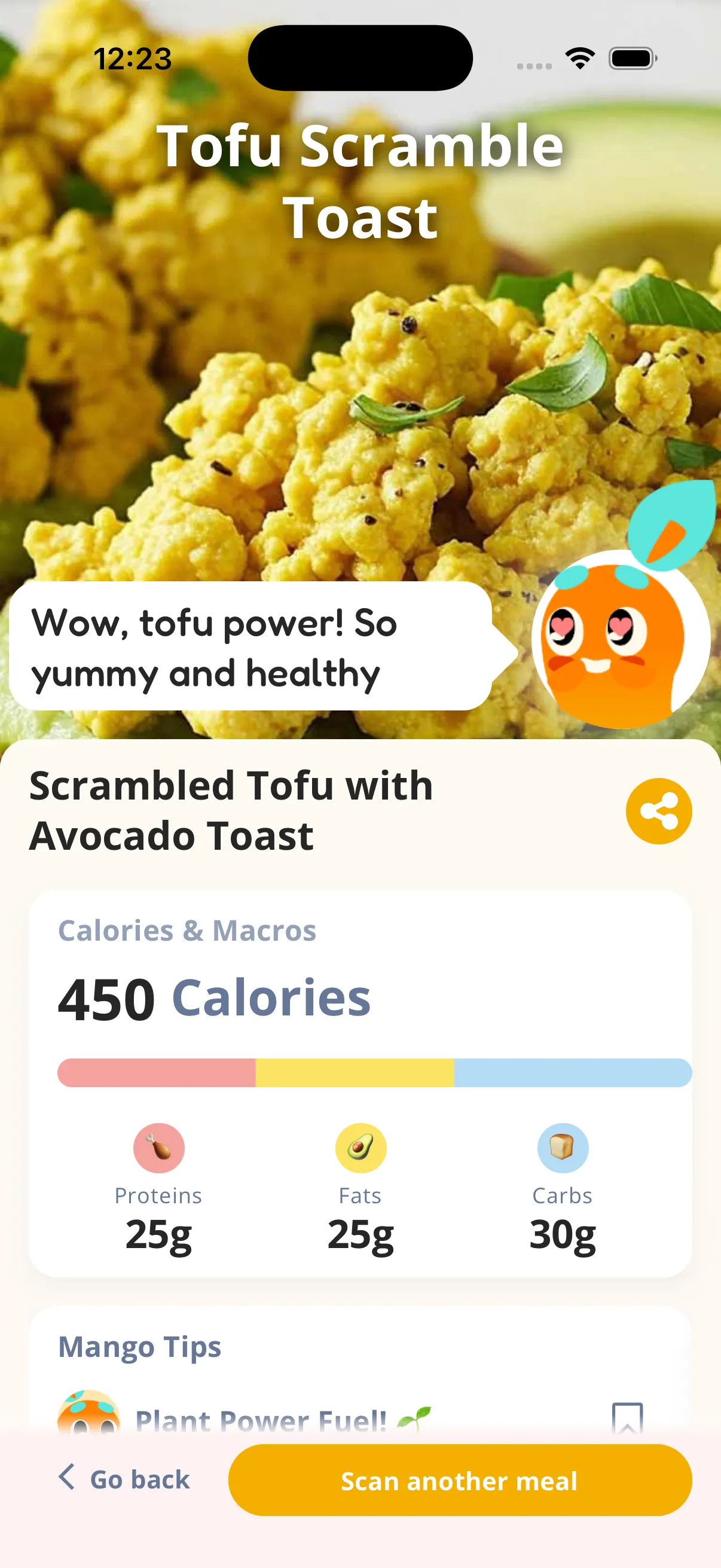
Snap what you eat and Mango Bites fills your protein, carbs and fat as the day goes on, without weighing anything or typing ingredients.
On iPhone and Android. Or try one photo here first
What this page cannot do
Macros are easy to plan and hard to count. That is the part the app does.
Nobody tracks macros for long by weighing chicken and typing in ingredients. Mango Bites reads them from a photo of your plate, so the grams on this page turn into a running total you can see during the day.
- Photograph a meal and get calories, protein, carbs, fat and fiber in seconds
- Your daily macros fill up as you eat, so you know at lunch whether dinner needs more protein
- The same five plans as this page, set from your goal in onboarding
- Mangi reacts to every meal, so a good day actually feels like one

What to do with this
Lock protein first
It is the macro that protects muscle and keeps you full. Build each plate around it and let carbs and fat fill the rest.
Treat grams as a range
Landing within 10% of each number most days is what works. Chasing the exact gram is what makes people quit in week two.
Check after two weeks
Formulas are averages. If your weight has not moved the way you expected after two to three weeks, adjust calories by 100 to 150 and keep the split.
How this is worked out
Mifflin-St Jeor, then a split by calories
kcal = BMR × activity ± goal · protein g = kcal × share ÷ 4 · carbs g = kcal × share ÷ 4 · fat g = kcal × share ÷ 9
Resting energy comes from the Mifflin-St Jeor equation, the one dietitians use because it was the most accurate in head-to-head comparisons. It is multiplied by your activity level to get maintenance.
To lose weight we subtract the energy of 0.5 kg a week (about 550 kcal a day), but never below 1,200 kcal for women or 1,500 for men and never more than 25% of maintenance. To gain, we add a quarter of that, about 275 kcal, because a bigger surplus mostly adds fat.
The macro shares are the same five plans the Mango Bites app uses, so this result matches what the app sets after onboarding. Protein and carbs carry 4 kcal per gram and fat 9. Fiber is 14 g per 1,000 kcal, the US Dietary Guidelines adequate intake.
The five macro plans, side by side
Shares of daily calories. Pick the one you can keep, not the one that sounds strictest.
| Plan | Protein | Carbs | Fat | Suits |
|---|---|---|---|---|
| Balanced | 30% | 40% | 30% | Most people, most goals |
| Low carb | 30% | 20% | 50% | Steadier hunger, less bread and pasta |
| High protein | 40% | 30% | 30% | Losing fat while keeping muscle |
| Keto | 20% | 5% | 75% | People who already like eating that way |
| High carb | 20% | 60% | 20% | Endurance sport, long training days |
Questions people ask
How do I calculate my macros?
How do I calculate my macros?
Find your maintenance calories, adjust them for your goal, then multiply by the share of each macro. Divide protein and carb calories by 4 and fat calories by 9 to get grams. This calculator does all three steps with the same formulas the Mango Bites app uses.
What is the best macro split for weight loss?
What is the best macro split for weight loss?
The one you can keep. Studies comparing low-fat and low-carb diets with the same calories find very similar weight loss. What matters most is the calorie deficit and enough protein, around 1.6 to 2.2 g per kilo, to hold on to muscle.
How many grams of protein, carbs and fat should I eat?
How many grams of protein, carbs and fat should I eat?
For a 1,800 kcal balanced plan it is about 135 g of protein, 180 g of carbs and 60 g of fat. Your own numbers depend on your size, activity and goal, which is what the calculator above is for.
Do I need to hit my macros exactly?
Do I need to hit my macros exactly?
No. Being within about 10% of each target on most days gives you nearly all the benefit. Calories and protein matter most; carbs and fat can swap between each other from day to day.
Is keto better for losing fat?
Is keto better for losing fat?
Not when calories and protein are equal. Keto can make hunger easier for some people, which helps them eat less, but it is not a shortcut by itself and it is the hardest plan to keep.
Why does the app split the day 30 / 30 / 30 / 10?
Why does the app split the day 30 / 30 / 30 / 10?
Three similar main meals keep protein spread out, which is better for muscle, and a small snack covers the gap most people feel mid-afternoon. You can move calories between meals; the daily total is what counts.
Sources
- Mifflin MD, St Jeor ST et al. (1990). A new predictive equation for resting energy expenditure
- Institute of Medicine (2005). Dietary Reference Intakes for Energy, Carbohydrate, Fiber, Fat, Fatty Acids, Cholesterol, Protein, and Amino Acids
- ISSN Position Stand: Protein and Exercise (Jäger et al., 2017)
- Hall KD et al. (2011). Quantification of the effect of energy imbalance on bodyweight. The Lancet
This is an estimate, not medical advice. Formulas like these describe averages, and you are a person rather than an average. Medication, thyroid conditions, pregnancy, breastfeeding and a history of disordered eating all move these numbers. Talk to a doctor or a registered dietitian before making a big change.
Related reading
Try another calculator
Each one works the same way: your numbers, spread across a real day, free and without an account.